THE BONDS FORGED BY WAR LAST A LIFETIME

By LTC Rick Stetson (Ret), 9th Infantry Division, Long Range Patrol

As told by Prescott “Smitty” Smith and Duane “Poncho” Alire.

DEDICATION

This narrative is dedicated to the E50 LRRPs/E75 Rangers who were killed in action in Vietnam between 1967 and 1971 and speaks to the “bonding of warriors” that today unites the men on the 50th anniversary of their military service.

Duty Calls

In 1968, during the Vietnam War, Prescott “Smitty” Smith and Duane “Poncho” Alire served in the same U. S. Army unit, “E” Company, 50th Infantry, 9th Infantry Division, Long Range Reconnaissance Patrol (LRRP).

Smith and Alire had very different birth places, family backgrounds and personalities, but in the real life or death setting of war – the two men bonded and were blessed with leadership qualities, skills and responsibilities that ultimately led to their becoming life-long friends.

Alire, from Monte Vista, Colorado, was drafted and promptly inducted into the Army in Denver, Colorado in July 1967. He was assigned to Fort Campbell, Kentucky for basic training. Shortly after his arrival at Fort Campbell, while undergoing initial processing from civilian to military life, Alire made, what he thought at the time, a simple helpful suggestion. While moving folded bunk beds into an empty barracks, Alire noticed two trainee soldiers struggling to fit a bunk bed through an open doorway. Seeing their dilemma, he suggested that if they turned the folded bed 90 degrees it would fit easily.

As he walked away from the barracks, a drill sergeant (DI) stopped him and asked, “What is your name?” Alire, still not dressed in a U. S. Army uniform, knew instinctively after several days of being hollered at and ordered around like an undisciplined child by men dressed as this DI was dressed, the man was not to be trifled with. He quickly responded, “My name is Alire”, and slowly spelled out his Hispanic last name – one letter at a time. He was summarily dismissed.

The next morning at 05:30, the man with the distinctive flat brimmed campaign hat now stood on the steps in front of the newly outfitted barracks with a clip board in hand. He began explaining the way things were going to be for the next several months. After a few minutes, he asked everyone to take a step back and then announced, “These are my trainee squad leaders. You will follow their orders because they are essentially my orders.” He then turned to a subordinate DI and asked, “Where’s the short Mexican?”

Alire, who had earlier sequestered himself in back of the 40 or so trainees, scrunched down, hoping not to be noticed.

The young DI walked around looking up and down the rows of young men and then announced, “Here he is” and placed his hand on Alire’s shoulder. The senior DI asked him to bring Alire forward before saying, “You are my first squad leader. You are responsible for the 10 men in your squad. They screw up, it’s your fault”. Thereafter he selected an additional 3 trainee squad leaders and a single trainee platoon leader. Alire served as the trainee first squad leader for the entire training cycle. Unbeknownst to Alire at the time, his suggestion to his fellow trainees cast a die that would lead him to the LRRPs.

In September 1967, Alire completed the Army’s Basic Combat Training at Fort Campbell and was assigned to Fort Polk, Louisiana for Advanced Individual Training (RVN oriented). By December he was home on leave with orders to report to a transit station in Oakland, California on January 3, 1968 for deployment to Vietnam.

Smith, from Sacramento, California, was a college graduate and after being drafted in mid-March 1966, was ordered to Fort Ord, California. At Fort Ord he volunteered for Officer Candidate School (OCS), selected infantry for his OCS specialty, and was ordered to Fort Dix, New Jersey for the Army’s Basic Combat Training and Advanced Individual Training.

Smith recalls his decision to volunteer for OCS in his book titled, Last Light With The Boys, when one of the other potential OCS candidates said to him,

“So what are you going to do, buddy?”

Smith responded, “I think I’m going to take that test and see if I can go to OCS.” The other man froze for a split second as the room became quiet.

“You’re making a big mistake, I hope you know that.” the man replied “You’ll be in Vietnam in less than two years and get your ass shot off.”

Smith replied, “I don’t need you worrying about my ass. I don’t know you, I don’t like you, and in two more days I probably will never see you again.” The man, according to Smith, seemed shocked at his response.

Unbeknownst to Smith at the time, his response to the man and his decision to go to OCS cast a die that would lead him to the LRRPs.

Smith completed the Army’s Basic Combat Training and Advance Individual Training (RVN oriented). He graduated from OCS, earned his airborne “jump wings” and completed the Army’s Pathfinder School. He was prepared to insert into a combat operational area by parachuting from an aircraft or by repelling from a helicopter. He was also trained to plan and execute pathfinder missions and to escape and evade, if necessary.

In January 1968, the young men were in Vietnam. They were fully trained, confident and highly motivated, and they were both assigned to the 90th Replacement Battalion at Long Binh. One was an officer – the other a private first class. It was here their paths diverged – officers went one way and enlisted men another – only to re-converge later.

Following an orientation to Vietnam both men were assigned to the 9th Infantry Division’s (“Old Reliables”) Reception Center at Bear Cat, the division’s basecamp until it was later moved to Dong Tam near My Tho.

At Bear Cat, Smith was assigned to the 9th Pathfinder Detachment of the 9th Aviation Battalion. During this assignment, Smith trained soldiers of the Royal Thai Regiment (The Queen’s Cobra) in airmobile operations. He was awarded Thai Jump Wings when he made a friendship jump with the Thai soldiers.

Alire, right, and teammate Ray Gallardo, before a mission northeast of Bear Cat.

Alire volunteered for duty with “E” Company, 50th Infantry (LRRP). He began his formal orientation and training to become a member of a 5-man long range reconnaissance patrol team. After successfully completing the training program, he would serve as a LRRP patrol member, point man and team leader.

On January 30, 1968, the armed forces of the Viet Cong (VC) and North Vietnamese People’s Army of Vietnam (NVA) launched the Tet Offensive. It was one of the largest military campaigns of the Vietnam War. The offensive was a series of surprise and sustained attacks by the NVA and VC against U. S. and allied military and civilian command and control centers throughout South Vietnam. January 31, 1968 was the single most lethal day of the war for American troops when 246 personnel were killed or mortally wounded.

Alire recalls, “Tet exploded around me as beautifully as any 4th of July fireworks display back home”, adding later, “Now this was a real shooting war”.

By the first of February, both men found their respective units fully engaged in the Tet Offensive.

Certificate from MACV RECONDO SCHOOL

In mid-February Smith departed Bear Cat by helicopter for Tan Son Nhut Air Force Base near Saigon. From there he travelled to the MACV 5th Special Forces Group’s Recondo School at Nha Trang and completed the rigorous Recondo School in March. Soon thereafter, Smith volunteered for duty with “E” Company, 50th Infantry (LRRP).

In March Alire, shortly before he was to report to the MACV 5th Special Forces Group’s Recondo School, was promoted to a LRRP team leader position – more responsibility – same pay.

Both soldiers would command LRRP teams. Sometimes the teams consisted of 5 soldiers; other times, as with Hunter-Killer missions, the teams expanded to 10 or more soldiers.

The LRRPs’ principal mission was to locate NVA and VC units and their infrastructure, i.e., base camps, staging areas, trails and supply routes and then to report their locations to the 9th Division’s G2 and G3. They were essentially the 9th Division’s eyes and ears in the field with “boots on the ground”.

Duane “Poncho” Alire on Patrol.

NOT the Saturday Night Bath. If you weren’t wet, you weren’t on Patrol.

They patrolled in Vietnam’s dense triple canopy jungle in III Corps and in the Mekong Delta’s swampy mud flats, rivers and canals in IV Corps.

Teams were inserted into their prioritized areas of operation (AO) by helicopter, ASBPs, PBRs, APCs, “stay behinds” from infantry units and occasionally, they walked out of a base camp through its defensive perimeter.

Inserting by PBR was nerve wracking. We were sitting ducks. But those Navy guys were not shy with those twin and quad 50’s when the need arose, which it did with alarming regularity.

UH-1D. The ubiquitous Huey. They put us in, sometimes under fire and took us out the same way. I can not say enough about the air crews and pilots. I was gonna name my first three kids “Huey” but my wife-Du-jour nixed that idea…

At times the teams deployed off the USS Benewah. The USS Benewah was a self-propelled barracks ship built on an LST class 542 hull. LST class ships were named after counties in the United States. The Benewah’s namesake was Benewah County, Idaho. The ship served as a mobile base camp and changed its position on the Mekong River frequently.

The teams also conducted recon missions from the 9th Division’s base camp at Dong Tam and the division’s outlier bases at Nha Be, Tan An, Can Tho, Bear Cat and various other Fire Support Bases (FSB).

However, by mid-1968 “mission creep” began to erode the LRRPs primary focus from reconnaissance missions toward missions that would result in an increase in enemy “body counts”. Many of the LRRPs believed the shift in their mission was a misuse of the highly trained and skilled reconnaissance teams.

It wasn’t until mid-June that Smith and Alire actually met each other. Their fateful meeting occurred at Fire Support Base David, a camp approximately 400 meters square with artillery cannons strategically stationed at various locations throughout the camp.

The misuse of LRRP teams when they were farmed out to units within the 9th Division’s AO had become problematic. One such misuse resulted in a full blown kerfuffle at FSB David when Poncho’s LRRP team was ordered to “listening post” duty. Lt. Smith was dispatched to FSB David to resolve the misunderstanding. Smith writes in his book,

… the LRRPs in the tent didn’t seem to know who I was, but quickly the silence was broken as one of the men stepped forward and introduced himself. ‘Sir, I’m Specialist Bien,’ as he gave me a sharp salute. As I returned his salute, Bien turned and in a strong voice said, ‘Poncho, there’s a LRRP lieutenant here to see you.’ As I looked on the other side of the tent, I saw a short Hispanic man with a thick mustache moving toward me. As he moved closer to me, he blurted out, ‘I’m Alire, who the hell are you?’”

Although Smith was somewhat shocked by the greeting, he couldn’t help but smile as he instantly knew that this soldier had his shit together.

‘I heard we had a new officer in the unit, you must be him,’ Alire continued.

By this time, all the members of Alire’s LRRP team were at the tent and as he continued to look at me, Alire began to introduce them to me; not by rank, but by their last names.

‘There’s Bien, Smith, Bellwood, Pegram and Monroe and you can just call me Poncho.’

I didn’t realize it at the time, but I had just met Duane Alire from Monte Vista, Colorado, who would end up being one of my closest friends from my time in Vietnam.

‘I’m Lt. Smith. I’ve been in the unit a little over a month. I transferred from the 9th Pathfinders.’

‘Hell, we have two Smiths in the unit now,’ Poncho continued, as he pointed toward Specialist Richard Smith, who he had just introduced to me, and then added, ‘We’ll call you Smitty’.

As I look back on that introduction, I can remember vividly the uniqueness of that first meeting and the impression it had on me. Poncho was a no-nonsense guy, who called it exactly the way he saw it and his leadership style certainly demonstrated that point. In the six months I served in the LRRPs, Poncho never once called me Sir and it didn’t bother me at all. From the very beginning of our association, Poncho and I developed a relationship based on trust and confidence in one another.

E Company long range patrol members at FSB David. Prescott Smith (far right) and Duane Alire (third from right.

After Smith left the LRRP tent area, Alire turned to his team mates and said, “That’s an officer we can trust. You guys pay attention to him.”

Smith’s book also describes examples of how the 9th Division LRRPs operated and their unique support needs. He points out there were some higher-level commanders who did not know how to properly utilize the LRRPs while others understood how LRRPs could provide valuable “boots on the ground” intelligence.

One such officer who had the backs of the LRRPs was the 1st Brigade commander, Col. John Geraci. Smith described a time when a LRRP team was in contact about 10 clicks northeast of Fire Support Base Moore. The LRRPs managed to break enemy contact around 0200 hours and the team leader called the TOC and requested an immediate extraction. As Smith describes it in his book,

The assistant S-3 on duty in the TOC refused the request for extraction, stating that an extraction at night would be too dangerous and the team would have to wait until daylight for extraction. Poncho, who was the LRRP in the TOC monitoring the team’s radio transmissions, got into a heated argument with the assistant S-3 and threatened to kick his ass if an extraction helicopter was not sent to get the team immediately.

As the argument continued, Col. Geraci, who had been at Fire Support Base Moore earlier in the day inspecting troops, happened to walk into the TOC. When he asked what was going on, Alire informed Geraci that a LRRP team was in contact and the assistant S-3 would not approve an extraction helicopter.

Col. Geraci went ballistic and fired the assistant S-3 on the spot. He then got on the radio and using his call sign, ‘Mal Hombre’, he ordered an immediate extraction.

This brief exchange resulted in Col. Geraci achieving legendary status with the LRRPs. It also speaks to the personal relationships LRRPs, like the one Smith and Alire nurtured – without regard to rank – had with army commanders who understood and supported LRRP operations.

After The War

Both Alire and Smith maintained contact with each other over the years and shared many long distance telephone conversations. In 2009 one of their conversations culminated, as Poncho describes it, “two old warriors agreeing to meet in Washington D.C. for a week of sightseeing”. On that visit they agreed to plan a return trip to Vietnam – this time as tourists.

In April 2010 they travelled to Vietnam. As they departed from the San Francisco International Airport, Smitty reminded Poncho, “No regrets and no apologies. We were soldiers following orders”.

L to R: Bao Smitty Nghia Poncho Sa Nhan

Landing in Ho Chi Minh City, aka “Sai Gon”, they were met by 5 former South Vietnamese Rangers who served with “E” Company, 50th Infantry until the 9th Division rotated back to the United States in 1971. Beginning in early April 2010, and for the next three weeks, the five former South Vietnamese Rangers served again as hosts, translators and guides – just as they had in 1968.

Alire characterized their experience in the war saying “What we did as LRRPs in Vietnam was very dangerous work. We were very good at it and lucky.”

Jointly they summarized their war time experience saying, “We were tested and lived through the worst the war could throw at us and came home.”

After the war, Smith and Alire successfully pursued meaningful careers – Smitty as a highly regarded, celebrated college basketball coach and Poncho as a national park ranger and park superintendent. The two friends “led the way” both as Rangers during the Vietnam War and in their civilian lives after separating from the military. They nurtured a fledgling friendship formed long ago in a distant land into A Bond Forged By War That Lasted A Life Time.

Acknowledgments

This article was a cooperative effort and several individuals deserve thanks for providing information, answering questions and proof reading. I am especially indebted to Prescott Smith and Duane Alire for sharing their written words and their oral memories of their war time experiences, to Poncho for sharing his historic photographs and to Karen J. Purnell for her deft editorial touch and suggestions for clarity, continuity and readability.

Selected Bibliography

9th Infantry Division LRRP Unit History by the men that lived it

Hernandez, Bob. Bonding Of Warriors. True Stories Of The 9th Division LRRP/Rangers as told by the Brave Men That Lived Them: Compiled by Bob Hernandez. Self-published. Lulu.com, 2014.

Smith, Prescott. Last Light With The Boys: Self-published. Lulu.com, 2008. Revised 2019.

Stanton, Shelby L. Vietnam Order Of Battle. New York: Galahad Books, 1987.

About The Author

Rick Stetson was one of two Airborne/Ranger qualified 2LTs selected by the 9th Infantry Division at Fort Riley, Kansas in 1966 to form a long range patrol platoon. After the platoon began operations in Vietnam in 1967, it expanded in size to become E Company 50th Infantry (LRRP) and in early 1969, E Company 75th Rangers. Stetson served as the unit’s operations officer and got to know Smith and Alire after the war at E Company reunions.
 

Posted in 9th Infantry Division LRRP | Leave a comment

Our Friend is Gone

Gentleman, Family and Friends;

I recently learned that our friend, Kiet, suffered a massive stroke and has passed away.

Those of us who had the pleasure of serving with our PRU contingent need not be told about their effectiveness, genuine camaraderie or their warrior spirit. I firmly believe that I would not be here were it not for the keen eyes and quick triggers of Nhan, Kiet, Sa, Bao, Nghia and the others.

I have already received money and pledges from “the usual suspects” as a result of posting on our FB page. My goal wass to collect at least $500.00 by April 1. We exceeded that and to date we have collected $1750.00. I had sent $750.00 to my stepson, Ho Van Tuan, and he got the money to Nhan, who attended Kiet’s funeral. I had received more donations and sent them to Tuan who forwarded them to Hue, Kiet’s wife. I just received $100.00 which will go out the next time I send tuition monies for our other two kids, which will be in about two weeks. It is not too late to help. As usual, I will keep all donations private.

I have come to love and admire many Vietnamese people, especially my wife, Lan and Nhan and while I hate to label or classify any person(s), I have to say that were they able they would give more than they get.

You can send a check or money order to:

Sal DiSciascio
698 Prescott Rd
New Bern, NC 28560

or


Rest in Peace, Brother Kiet.

Thank you,

Sal

Posted in 9th Infantry Division LRRP, Uncategorized | Leave a comment

“E” Company LRRP Cook Book “FROM LRRP RATIONS TO GOURMET DINING”

Gentlemen and members of our extended family,

As you can tell by the letter below, this latest message is intended not solely for you but also your wife, sister, daughter, significant other, partner, etc. Sharon’s letter is self-explanatory.

As your Unit Director, I enthusiastically support the two initiatives Sharon has proposed. First, is a call for e:mail addresses to create an electronic contact list for the E50/E75 ladies (aka “Warrior Women”). And, secondly, is a call for recipes for a proposed cook book. Leading the way, I have already submitted one of my favorite recipes – a recipe for baked apples!

Please share the information contained herein and help us accomplish both initiatives.

Rangers Lead The Way,

Duane L. Alire
Unit Director, E50/E75

Dear E Co. Ladies (AKA Warrior Women),

I know this is the age of technology but sometimes snail mail is still the way to go. To those of you who attended the Reunion in Louisville or Baltimore, I just wanted to say how good it was to see y’all and spend some time together. To those who could not attend, please know you were missed and we look forward to seeing you in the future.

I have a couple of ideas for you to consider: First of all I am proposing an e-mail list of the women in the unit. That way, if we have news to share, ideas, requests or need information we can contact each other directly, instead of, for some of us, getting it secondhand through our Rangers. If you would be interested in getting on the list please e-mail the address to seb930@aol.com or text me at 716-574-8254. Once the list is complied, I will ask Sal to add it to the Unit website.

Secondly, in one of my fits of insomnia, I came up with a simple idea for us to help raise funds for the Unit. I am proposing creating a cookbook. One filled with recipes that might be your favorites or your Rangers, is representative of your area of the country, one that is just delicious or one you would just like to share. There would also be a Holiday (Christmas, Hanukkah, etc.) section. I know the holidays are a ways off right now, but, I am asking you to pull out your favorite recipes of cookies, fudge, breads, cakes, and pies, you wouldn’t mind sharing. Some of you have recipes for other desserts, beverages and punches. We would love for you to share one or two with the group. I will assemble the recipes and have them put into books that we can sell at the next and future reunions. Duane (Poncho) Alire has written a sample cover page for the book and has suggested a title “FROM LRRP RATIONS TO GOURMET DINING’. Hope you like it.

I have included an online form recipe form for you, if you are interested in participating or you can download a copy here. I am placing a deadline for submission for March 1, 2015. This will give me enough time to assemble the books and have them ready for the next reunion, Newburgh, NY, September 21-27, 2015

The only requests I have are: to type or print the form; to mail, or email the information to me. Please use common cooking abbreviations (example: tbsp. – Tablespoon). Don’t forget your name and state, your Rangers name, years in Vietnam and your relationship (wife, sister, daughter, significant other, partner, etc.). Also if your Ranger is a chef in his own rite and he has a recipe to share we would love to include it. Feel free to make copies of the form

I really hope you are all up to the challenge and submit some yummy recipes. Looking forward to hearing from all of you. Rangers Lead The Way.

Sincerely,

Sharon Barley
PO Box 233
Springville, NY 14141-0233

Posted in 9th Infantry Division LRRP, Uncategorized | Leave a comment

“Bonding of Warriors” Is Available on LULU.COM

Gentlemen and members of our extended family:

I have the great pleasure of announcing that Bob Hernandez has published our book which is titled, Bonding Of Warriors. The book is compilation of stories and narratives which represent our collective memories of our tours of duty in Vietnam.

The bulk of the written material used in the book was originally assembled from a call for stories that was put out to everyone nearly 10 years ago. The stories were available on the Unit web site but in a confusing format. Additionally, Bob, again, put out a call for additional stories when he began the project.

Bob literally worked day and night to type the stories and narratives into a format that could be published as a comprehensive book. I understand that due to computer errors or errors on the computer, depending on who is telling the story, Bob had to retyped portions of the stories and narratives a couple of times.

However, the bottom line is that he completed the task and finished the book! It is available at lulu.com.

I have attached as a Word Document the advertisement from the lulu site which contains a photograph of the cover page and additional ordering information.

I enthusiastically thank Tess for the design of the book cover and Bob his self-sacrifice and diligent work in compiling our stories and narratives and ask everyone to personally thank them at the earliest opportunity.

Respectfully submitted,

Duane L. Alire

Buy it Here: Bonding of Warriors

Posted in 9th Infantry Division LRRP, Uncategorized | 1 Comment

July 2014 Unit Calendar and Information

November 8, 2014 is the date of the Veterans Day running of the Half and Marathon in Santa Barbara, California.

This note was sent to me by the Mr. Chuck Howe, President of the David Westphall Veterans Foundation.

Dear Duane,
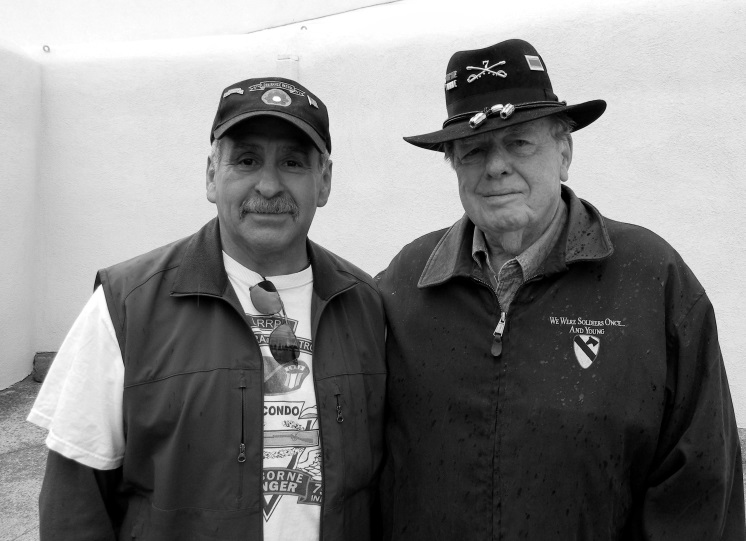
PonchoandChuckIt has been beautiful in the Angel Fire area this spring and the rains started last week so we are hoping for a very green summer. Our big news is that the Governor of New Mexico, Governor Susana Martinez has nominated ten acres immediately south of the Memorial as one of four rural veterans’ cemeteries to be built in the state. It will be built to national standards and maintained as a state cemetery. The cemetery will be open to veterans and qualified family members from all states. The concept needs to go before Congress for final approval and we will be contacting you in the near future to assist with this. The land was donated by two Vietnam veterans, Harry Patterson, Wichita Falls, TX and Stan Samuels, Angel Fire, NM.

The Memorial Day program was fabulous this year with Joe Galloway the co-author of We Were Young Once, and Soldiers as the primary speaker. Congressman Ben Ray Lujan also spoke. We had approximately 500 in attendance.

Chuck

Posted in 9th Infantry Division LRRP, Uncategorized | Leave a comment

Memorial of Eternal Gratitude

Memorial of Eternal Gratitude This article was written by Michael Poole November 08, 2013 for the Crescent City, California Del Norte Triplicate newspaper. The “Hey Ranger” column appears monthly.

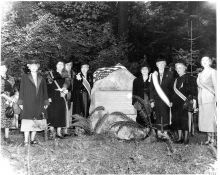
“Hidden in the redwoods is a national tribute to veterans Del Norte County has a hidden jewel. A national heritage hiding in plain sight, it is a magnificent but forgotten tribute to the men and women who fought and helped will World War II – the National MemEterGratTribute Grove. In the waning years of the war, a drive went out to form memorial to its veterans. Small memorials were established all over the country, but one in particular had national significance and it’s been here under our noses for the last 64 years. Attendees at a 1949 dedication ceremony include DAR president general Estella O’Byrne, just left of the monument, Estelle Christin, national chairwoman of the Conservation Committee, just right of the monument and May Talmadge, right of Christin, honorary DAR president general. Photograph courtesy of the National Society for the Daughters of the American Revolution. Located in what is now the Jedediah Smith Redwoods State park unit of Redwood National and State Parks, the National Tribute Grove includes 5,000 acres of old-growth redwood forest preserved with a dual purpose: to remember and honor the American who came forth when their country called them to fight, and to preserve this redwood grove as part of America’s heritage. The groove was meant to be a memorial-like no other. Sequoia Sempervirens, the trees’ scientific name, translates roughly as Sequoia ever-green or ever-living. Some of these trees live as long as 2,000 years, longer than most man-made monuments. No More Fitting Tribute The founders of the memorial thought the ancient and scarred trees a most fitting medium to remember the veterans of WWII. Dr. Ray Lyman Wilbur, a former secretary of the interior, said, “Instead of stone or concrete, this monument is made up of living trees, survivors of centuries of combat with storms, drought, fire and flood.” At the start of the war, this section of land was owned by the Del Norte Lumber Company. Save the Redwoods League contracted with the company to buy the land as 10 500-acre parcels and asked Americans to donate to the cause. In the words of Newton Drury, director of the National Park Service in 1949, the grove was to be known as an ever-living “memorial of eternal gratitude, eternally expressed” to those men and women who served in the armed forces of the United States in World War II and so preserved American freedom. A National Treasure Why is this grove special? Because Americans bought into the idea. Proud of their country’s contributions to the war effort and of their courageous veterans, donations came in from Americans all across the country. No donation was too small. Donors could give money along with the name of the veteran who fought in the war. The 5,000 acres purchased with these donations are today almost half of the entire Jedediah Smith Redwoods State Park. The names given with the donations were to be enshrined in a Golden Book. One copy was to be kept in the state and another to be kept in Washington, D. C. Adopting the grove as a national project, the Daughters of the American Revolution (DAR) took up the goal of purchasing the final 500-acre parcel, raising an impressive $26,430 through thousands of 10-cent to 29-cent-per-member donations. The state of California then matched the DAR donation dollar for dollar to complete the final purchase. On September 25, 1949, a monument was erected on Highway 199 with a dedication ceremony. Located on the only strip of the grove bordering the highway, the monument was placed so that all who travelled the road would see it and remember. People came from all over the country to attend, including members of the DAR’s executive committee and representative so California State Park, the National Park Service, and the U.S. Forest Service. Unless We Conserve ….” Mrs. Roscoe C. O’Byrne, the DAR president general, gave a poignant speech highlighting the importance of the trees not only to the veterans, but also to America as a whole. About conservation, she said, “We recognize that conservation is of vital importance to this country. Unless we conserve, we shall be among the nations that have not. Preservation of this grove is a lesson in conservation to every American. We should apply this lesson not only to our trees, but to our very national life.” (Mrs. O’Bryne’s words were perceptive: today only 5% or approximately 117,000 of the original 2 million acres of ancient coast redwood forest remain.” She concluded, “In loving memory of the men and women of our country who served in the world war, we dedicate these trees to their courage, to their fidelity and to their sacrifice. May this ‘Land where our fathers died’ never be despoiled by the enemies of democracy. May these trees stand through the centuries as living symbols of the enduring strength of a free people, a great nation, our own Untied States of America.” It is a powerful story that the grove was created, but an equally powerful story that its location and meaning have been largely forgotten over time. Near the current entrance to the park campground, the memorial still sits in forest shade about 20 feet off the highway. Hundreds of people drive past it every day, not realizing it is there. There are few left who remember. Along the noisy highway in a place that is now dangerous to stop, the memorial stone may not be the best place to appreciate the National Tribute Grove. Instead, drive the Howland Hill Road. Most of the northern side of the road is the grove. A great place to appreciate it is the Boy Scout Tree Trail parking area. Close your eyes and imagine those fighting WWII. Hear the sounds of the guns and bombs. In your mind’s eye, picture the soldiers. Then, open your eyes and let the quiet take over. This is why redwoods were chosen for the memorial. Big trees that have survived eons and will stand eons more are now an ever-living peaceful refuge. On this Veterans’ Day, remember our nation’s heroes and be thankful these trees are here for them and for you.”

Posted in 9th Infantry Division LRRP, Uncategorized | Leave a comment

Protected: Member List

This content is password-protected. To view it, please enter the password below.

Posted in Uncategorized | Enter your password to view comments.

SECURE AREA, MEMBERS ONLY!!!

cropped-flagimage2This is the “Members Only” area. This area is, currently, under construction. If we can get our webmaster to stay out of the Jack Daniels for a few days, we should have something to look at, but I wouldn’t hold my breath…

Later…

Posted in 9th Infantry Division LRRP, Uncategorized | 3 Comments

Johnston Dunlop Barracks Dedication Ceremony

To: E Company Rangers
From: Rick Stetson
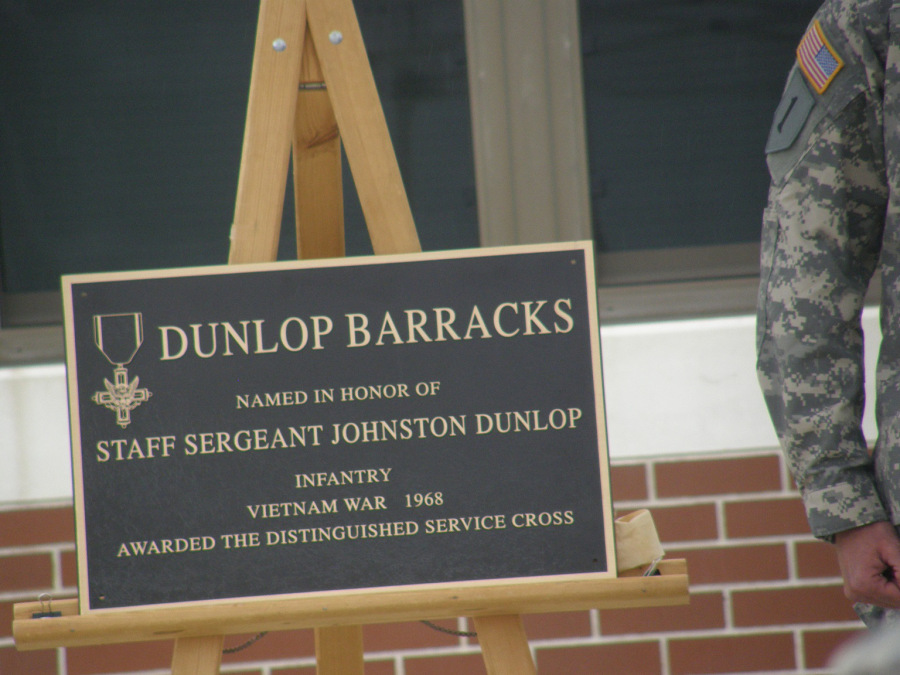
dunlop1Attached is a photo of the plaque that will be attached to Dunlop Barracks at Fort Benning, Georgia. Those who served with SSG Johnston Dunlop can attest that the brave and dedicated member of the 9th Division’s long range patrol company is most deserving of the honor of having the Echo Company, 1/50 Infantry Battalion barracks named for him.
The 50th Infantry was organized June 1, 1917 at Syracuse, New York, which incidentally, is the state where Dunlop was from. The unit was assigned to the 6th Armored Division in WWll which was part of Patton’s Third Army. In Vietnam, the 1/50th was assigned to ll Corps as General Reserve and worked with the 1st Cav, the 4th ID and the 173rd Airborne Brigade. For a period of time, the 9th Division’s long range patrol was assigned to the 50th Infantry although the Rangers never worked directly with the unit.
The 1/50th participated in ten major campaigns in Vietnam. On May 5, 1968, the battalion had 18 soldiers KIA during the battle of An Bao. The unit has an active veterans organization that sponsors a wreath laying ceremony at their memorial in Fort Benning’s Sand Hill area of the post. When the 1/50 decided to dedicate their battalion barracks to heroes who had served in the unit, four soldiers were selected who had died in Vietnam, two who lost their lives in Afghanistan and one who was KIA in Iraq. Jim Sheppard, the unit’s historian, recommended Johnston Dunlop as the soldier whose name should be attached to the Echo Company barracks.
The ceremony last week to honor the fallen soldiers took place under threatening skies as sounds of automatic weapons from distant ranges filled the air. We were seated in front of a bronze memorial featuring an inverted rifle with helmet on top and a pair of combat boots to the front. To the rear was a glass container with soil from Vietnam where the Battle of An Bao was fought.
After a prayer and the singing of the Infantry and Army songs, a bio was read about each soldier after which family members were asked to stand and be recognized followed by those present who had served with the fallen soldier. Johnston’s niece, Cindy Dunlop, her husband, Jim Gallagher and their sons, Takoda and Ryan, were then escorted forward where Cindy unveiled the plaque that will be placed on the Echo Company barracks.
The guest speaker was LTG (Ret) Carmen Cavezza who delivered appropriate remarks that were kept brief as a light rain had started to come down while he spoke. A large wreath containing red and white flowers was placed in front of the memorial and it was announced that the wreath speaks to the “beauty and brevity of life.” Taps was played and then we moved inside for a lunch of MRE’s which have come a long way from the C’s and lurp rations we ate in Nam. Each MRE contained a heating element to warm the meal so that C-4 is no longer required.
After lunch, E Company First Sergeant, Gary Stout, invited Cindy, her family and me to tour the E Company barracks. When we reached the modern Army barracks that housed the entire company, we noted there was already a sign in front letting people know this was Dunlop Barracks, the home of Echo Company. We climbed steps to the second floor and stood in front of a framed unit photo taken in 1967 of E Company Rangers during our organization day at Bearcat. The 1/50th is now a training battalion “turning civilians into soldiers.” It was moving to realize that as the young soldiers pass by each day and see the photo of Dunlop and the other members of E Company Long Range Patrol, the sacrifices made in Vietnam will not be forgotten.
Part of the bio read about him at the memorial ceremony stated, “At the age of 29, Staff Sergeant Johnston Dunlop died a Warrior’s death in …Vietnam. He gave all he had and then some in his quest to complete the mission. As a result of his gallant actions while engaging the enemy, he was posthumously awarded the Distinguished Service Cross. Through his selfless service and dedication to duty he made the ultimate sacrifice in upholding the highest traditions of the Ranger Creed, ‘I will never leave a fallen comrade behind.’ Staff Sergeant Dunlop by way of his gallant actions truly exemplified the Ranger Motto, ‘Rangers Lead the Way.’ “
It is fitting that Johnston Dunlop’s name on the E Company barracks will continue to inspire future generations of soldiers. Our sincere appreciation goes to Jim Sheppard and his fellow veterans as well as the active duty members of the 1/50th for the impressive dedication and memorial ceremony and for remembering one of our own.
Posted in 9th Infantry Division LRRP, Uncategorized | Leave a comment

Long Range Patrol, Viet Nam – Video

Sal DiSciascio posted this to the 9th Division Facebook group… Thanks Sal for finding it!

Rick Stetson

Long Range Patrol, Viet Nam

Posted in 9th Infantry Division LRRP, Uncategorized | Leave a comment